
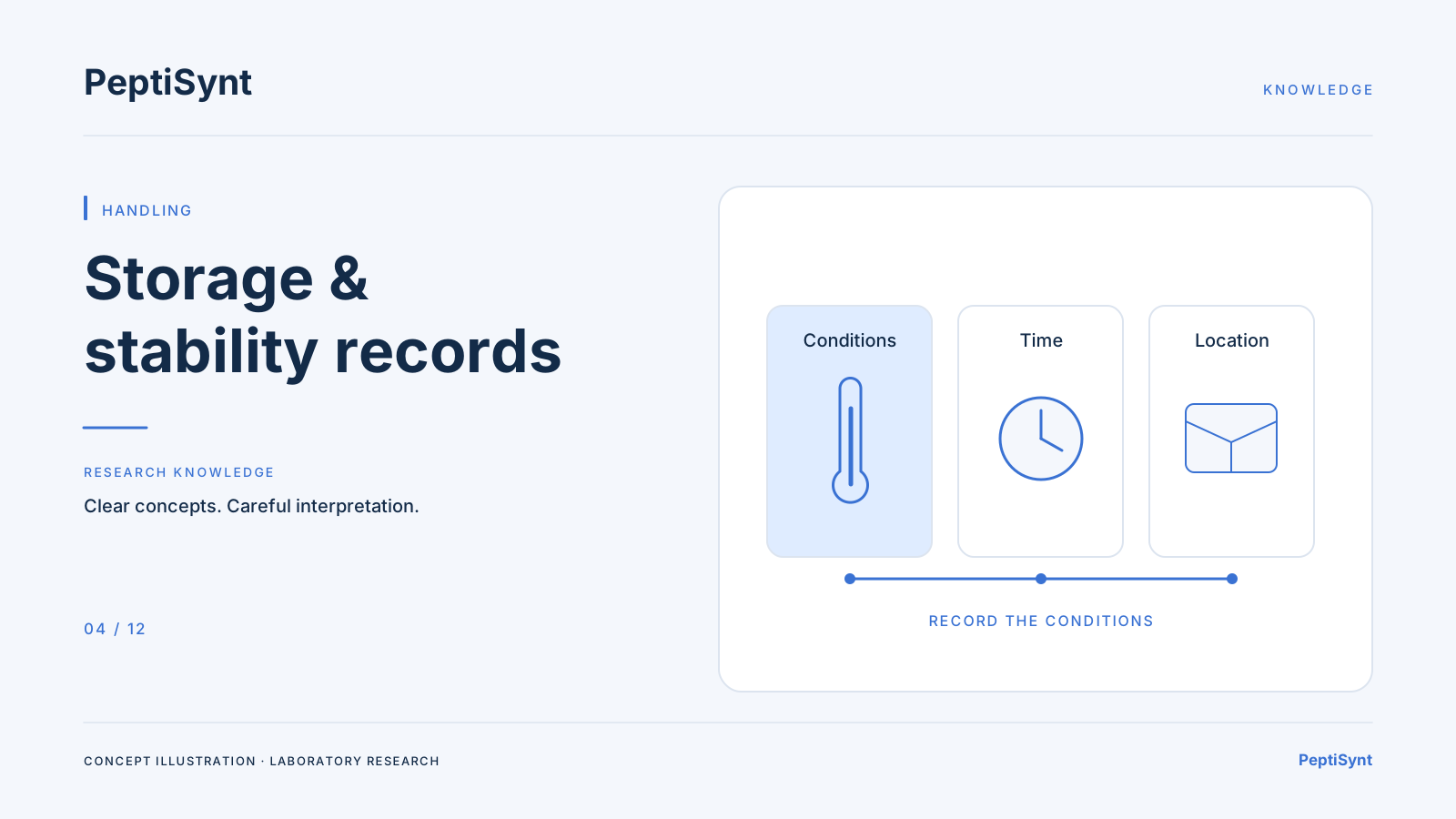
PeptiSynt separates the conditions used to store a sample from evidence that the sample remains suitable. Those two records should be connected, but they are not interchangeable.
Begin with material-specific instructions
Use the label, safety data sheet and supplier’s applicable instructions for the exact material and form. Dry material and a prepared solution need separate records. Do not apply a generic online storage table as a batch-specific stability guarantee.
Technical peptide-handling guidance highlights that composition and preparation affect behavior. The laboratory still needs to establish conditions appropriate to its own material and method. A general reference cannot supply missing expiry, retest or solution-stability data.
Record the history that future interpretation needs
- Material and lot identifier.
- Physical form and preparation reference.
- Storage location and the applicable instruction version.
- Dates of receipt, opening, preparation and use.
- Known temperature excursions, transfers and unresolved observations.
Link each working sample to its parent lot. If a storage instruction changes, retain the previous version and note when the new instruction took effect. This preserves what was actually known when earlier work was performed.
Handle an excursion as a documented question
Record what happened, how long it was observed and which samples may have been affected. Seek a qualified assessment using the available material-specific evidence. A return to the intended storage condition does not itself demonstrate that the earlier exposure had no effect.
Appearance can be included as an observation, but it does not replace analytical evaluation. Keep observations, measurements and decisions in separate fields so their basis remains clear.
Frequently Asked Questions
Is there one storage rule for all peptides?
No. Use the instructions and supporting evidence applicable to the material, formulation and research method.
Can a normal-looking vial establish stability?
No. Visual appearance is only one observation and does not establish chemical integrity or suitability.
Sources and further reading
Continue reading
For laboratory research use only. Not for human or animal use.