
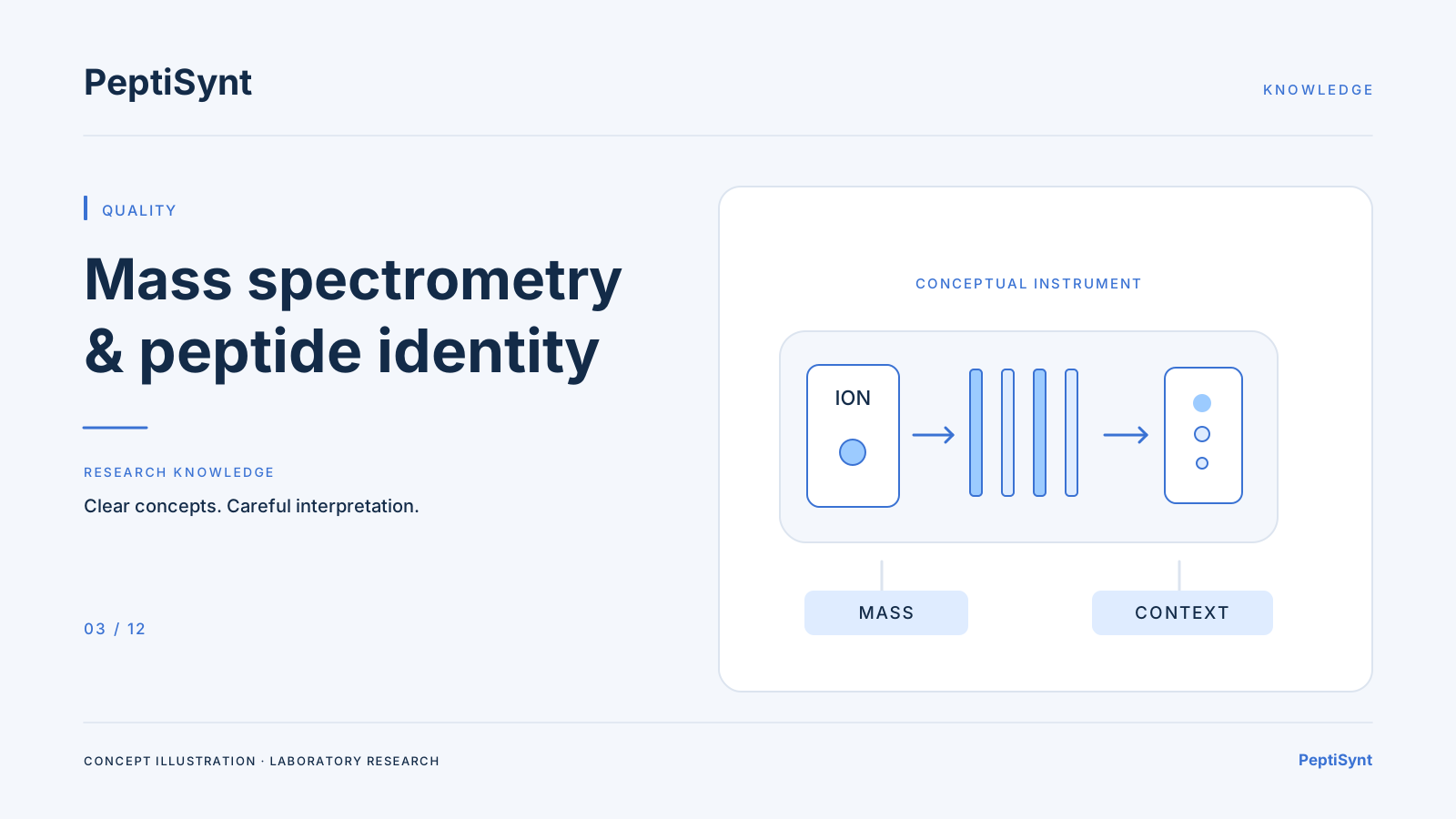
For PeptiSynt, the important step is the assignment between an observed ion and a proposed molecular species. That assignment needs enough context to be checked.
Read the axes and assignments
Mass spectra report ions by mass-to-charge ratio, commonly written m/z. Peptides may appear in multiple charge states, so the value on the horizontal axis is not necessarily the neutral molecular mass. The report should explain the mass convention and ion assignment used for comparison.
The Waters primer linked below discusses charge states and mass conventions in peptide isolation. For your own review, write the expected value and observed value side by side, together with their units and the stated charge or deconvolution method. Do not compare an average mass with a monoisotopic value without recognizing the difference.
Keep the conclusion proportional to the evidence
A compatible mass can support an identity assignment. It does not, by itself, fully establish sequence, stereochemistry, purity or the absence of all other species. What additional structural evidence is needed depends on the specific research question.
If a figure is difficult to read, request the original analytical report rather than estimating a result from a small product-page image. Keep the sample identifier, acquisition method and interpretation with the spectrum so another researcher can understand the assignment.
A practical review note
Use four fields: expected species, observed ions, assignment assumptions and unresolved questions. Add the chromatographic reference if the data came from an LC-MS experiment. This simple separation makes it easier to distinguish a measurement from the interpretation built on it.
Frequently Asked Questions
Does an observed mass prove the whole sequence?
Not on its own. The strength of the structural claim depends on the analytical evidence actually collected.
Why can one peptide give several peaks?
Charge states, isotopic patterns and ion forms can contribute different signals; assignments require the acquisition and interpretation context.
Sources and further reading
Continue reading
- Chromatographic Purity, Content and the Missing Questions
- What a Peptide Certificate of Analysis Can Establish
For laboratory research use only. Not for human or animal use.