
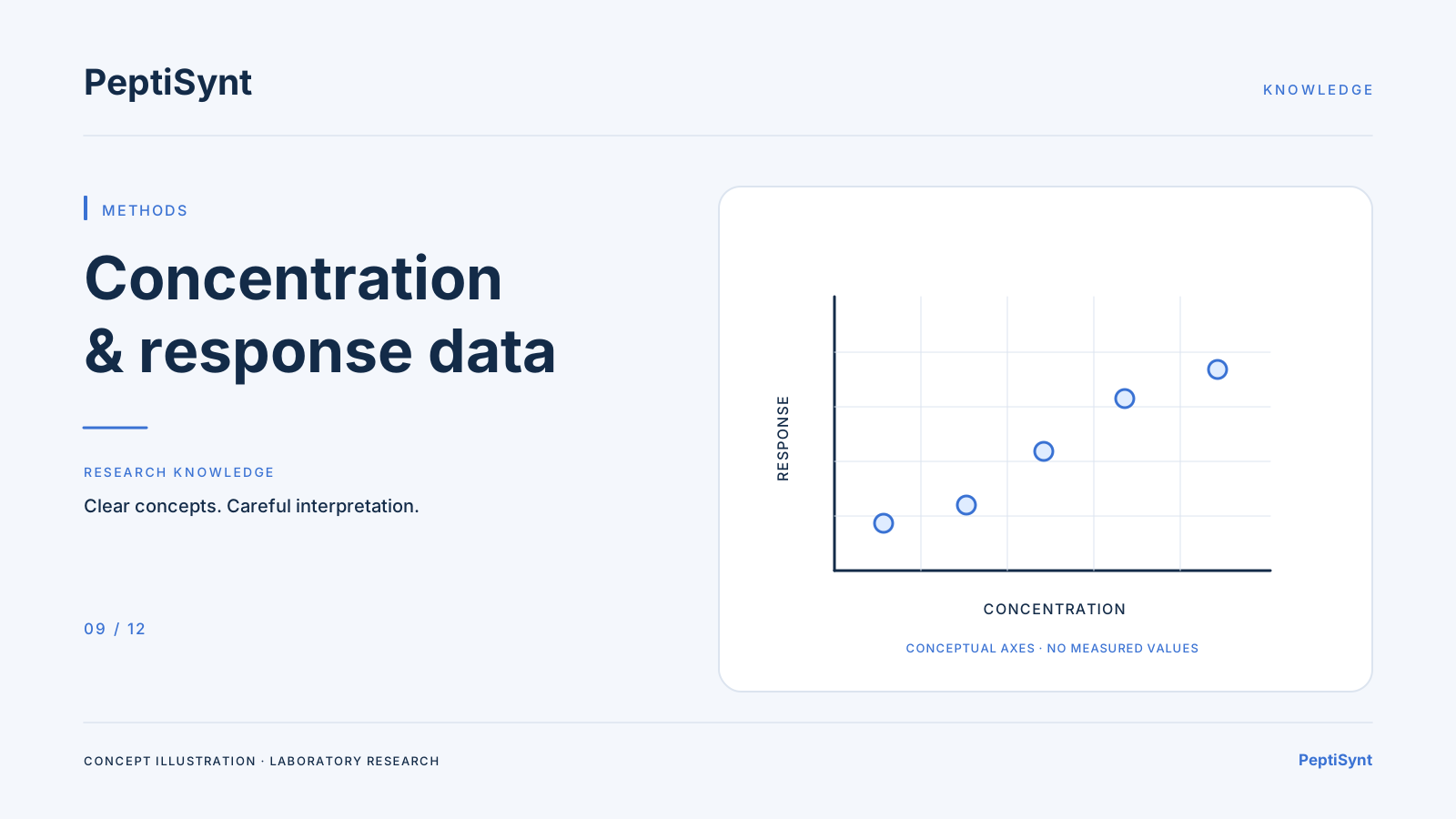
PeptiSynt asks whether the experiment supports the fitted model before comparing its parameters. The tested range and observed behavior matter as much as the curve’s appearance.
Start with the observations
Keep the tested concentrations, raw responses, control observations and units available. Record whether the response is increasing or decreasing, how it was normalized and what independent repeats were performed. State the experimental system and observation time.
The Assay Guidance Manual discusses concentration-response fitting in laboratory assay development. Terms such as EC50 or IC50 depend on the endpoint and analysis definition. Report what the chosen parameter means in the specific experiment rather than assuming the label is self-explanatory.
Show the analysis context
Record the model, any fixed parameters, weighting choices and treatment of missing or excluded observations. Keep the reason for each exclusion. Inspect the observed range, fit behavior and uncertainty; a numerical output from software does not by itself show that the parameter is well determined.
If the tested range does not support a reliable estimate, report that limitation directly. Avoid presenting an extrapolated value with the same confidence as a well-supported estimate. Predefined analysis choices and transparent exploratory follow-up make the distinction clearer.
Compare experiments cautiously
Two values obtained in different systems or with different endpoints may not be directly comparable. Check the material basis, preparation, controls, assay conditions and analysis definitions first. These laboratory estimates do not specify clinical efficacy, human dose or safety.
Frequently Asked Questions
Does a lower fitted value always mean a better research material?
No. Interpretation depends on the assay, endpoint, uncertainty and the question being investigated.
Should every dataset be forced into a curve model?
No. Use a justified model and report when the observations do not support a reliable estimate.
Sources and further reading
- Assay Guidance Manual: assay operations for SAR support
- Assay Guidance Manual: standardizing assay result definitions
Continue reading
For laboratory research use only. Not for human or animal use.