
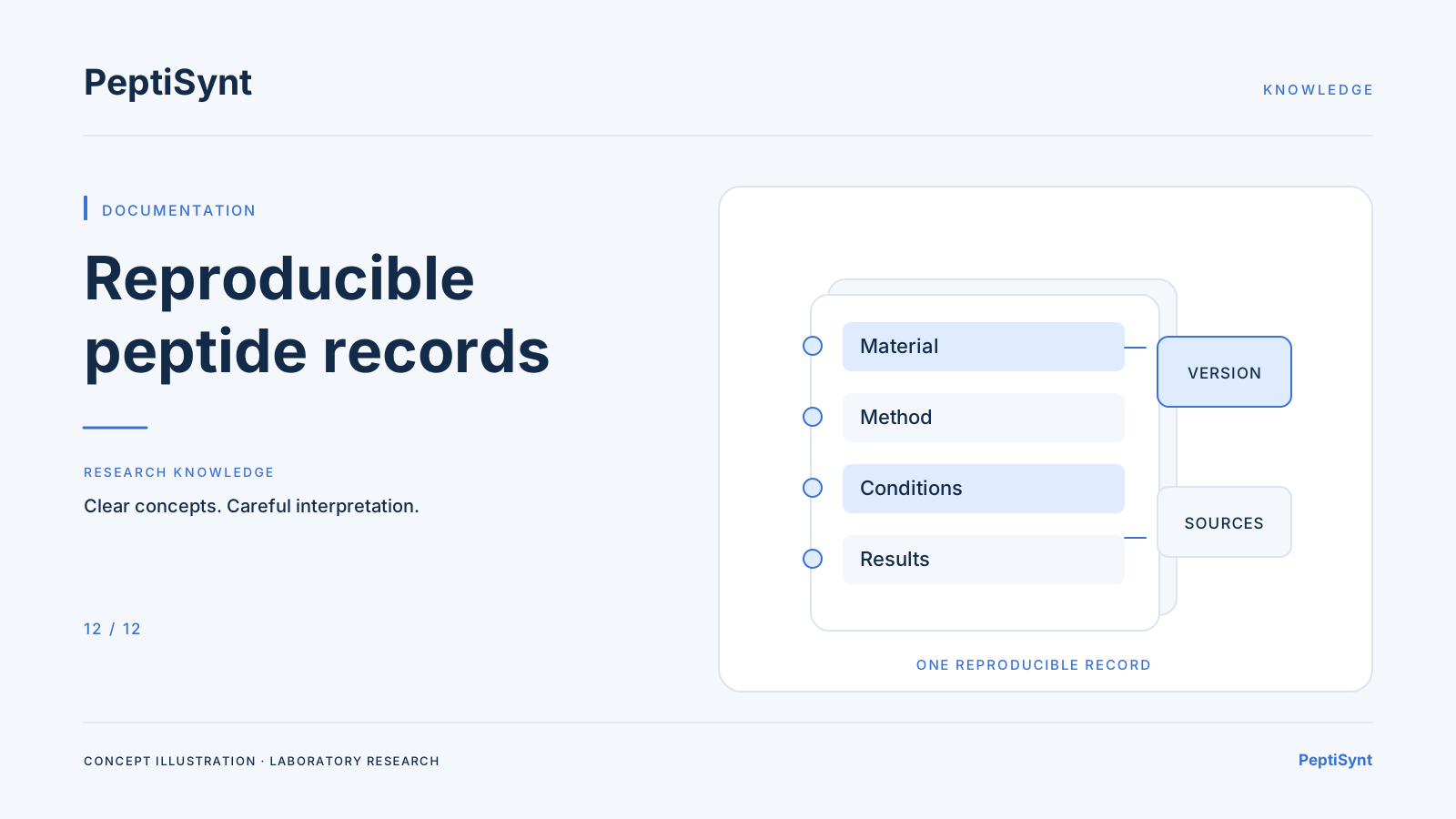
PeptiSynt emphasizes the separation between observation, analysis and interpretation. A reproducible record makes each of those layers available for examination.
Preserve the experiment, not only its conclusion
Keep the material and preparation identifiers, method version, instrument or assay context, control plan and original observations. Save the analysis settings and explain how the reported result was derived. A summary chart is useful, but it cannot replace the underlying data and decision record.
NIH’s reproducibility resources emphasize rigorous design and transparent reporting. For a peptide experiment, an actionable response is to decide in advance which information another researcher would need to evaluate or repeat the work.
Use a small record structure consistently
- Material: identifier, lot, chemical-form basis and document references.
- Preparation: working-sample IDs, quantities, conditions and history.
- Experiment: question, method version, controls and independent repeats.
- Analysis: raw-data locations, software or script version and choices.
- Interpretation: supported conclusions, alternatives and limitations.
Include unsuccessful runs and unexpected control observations where they inform interpretation. Distinguish decisions made before the experiment from exploratory decisions made after seeing the data.
Make the record understandable beyond the current team
Use stable identifiers, descriptive file names and explicit units. Link related files and explain specialized field names. Decide appropriate access and sharing arrangements for the data rather than assuming that reuse requires public disclosure of everything.
Before archiving, ask a colleague unfamiliar with the run to follow one result back to its source. Questions that remain unanswered are useful signals for improving the record template.
Frequently Asked Questions
Does complete documentation guarantee the result will reproduce?
No. It enables examination and repetition; it does not eliminate biological or analytical variability.
Should exploratory analyses be omitted?
Keep them, but label their timing and purpose clearly so they are not confused with the original analysis plan.
Sources and further reading
Continue reading
For laboratory research use only. Not for human or animal use.